

Anal Training and Size Play: How to Size Up Safely


This guide contains affiliate links. If you buy through one, we earn a commission at no extra cost to you. It never changes a pick. How we make money
Search anal training and you'll get a hundred schedules. Week one, smallest size, twenty minutes daily. Week three, size up. They're written with total confidence and we went looking for the research underneath them. There isn't any. No trial, no cohort study, nothing that tested a progression schedule against comfort or injury in a sexual context.
The injury literature, on the other hand, is detailed and consistent. Damage tracks with how hard and how fast, rather than with how wide. That single finding reorganizes the whole project: you progress by reading what your body reports back, not by following a calendar somebody posted on a forum in 2014.
This guide picks up where the beginner anal toys guide stops. Flared bases, first purchases, and basic lube volume are covered there and none of it is optional. What follows assumes you've done that part and want to know how sizing up works, what the evidence supports, and where the popular advice is making things up.
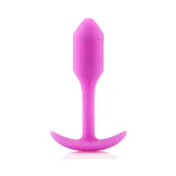 b-Vibe Snug Plug 1$50BEST STARTING POINT
Weighted, small, and designed to be worn rather than pushed. The best way to teach your body that fullness is boring.
See it at b-Vibe →Affiliate link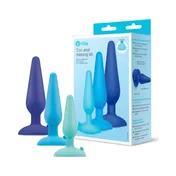 b-Vibe Anal Training Set$60BEST PROGRESSION SET
Three graduated plugs for less than two bought separately. If you know you want to progress, buy the set and stop shopping.
See it at b-Vibe →Affiliate link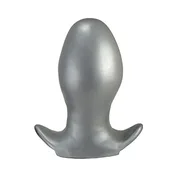 SquarePeg Egg Plugfrom $29BEST FOR SIZING UP
SuperSoft silicone compresses going in and re-expands once seated, so you can wear a width you couldn't insert in anything firmer. The size-play cheat code.
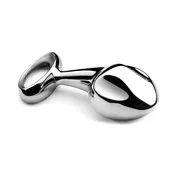 njoy Pure Plug$75BEST ADVANCED
Surgical steel, no give whatsoever, and heavy enough that gravity does the work. Buy it once you're comfortable, not to get comfortable.
See it at Intimatify →Affiliate link
Product photos: b-Vibe, SquarePeg, njoy.
Two Muscles, One Ignores You
You have two anal sphincters and they take orders differently. The external one is skeletal muscle under voluntary control, and it's what you're moving when you deliberately clench or let go. The internal sphincter is smooth muscle running on autonomic signals, and it has no interest in your decision to relax. It opens through a reflex triggered by pressure from inside the rectum, on its own timing. The anatomy of the anal canal is unambiguous on this split.
So "just relax" is incomplete advice. You can fully release the muscle you control and still meet resistance from the one you don't. Steady pressure held in place gets the internal sphincter to yield. Shoving does the opposite: push hard against a braced muscle and it braces harder, which is a feedback loop that ends in a bad evening.
The second piece of anatomy matters more and almost nobody covers it. Sensation in the anal canal changes at the dentate line. Below it, the tissue is wired into the pudendal nerve and reports pain, temperature and touch in high resolution. Above it, innervation is autonomic and registers stretch rather than sharp pain.
Your warning system is loud at the entrance and quiet further in. Damage deeper up can happen without the pain you'd expect to accompany it. That asymmetry is the whole argument for moving slowly instead of assuming you'd feel it if something were going wrong.
What Training Actually Does
The claim that gradual dilation permanently increases your capacity has, as far as we can find, never been tested.
Dilators are real clinical tools and we're not dismissing them. Doctors use graduated dilation for anal stenosis, during fissure recovery, and in Pelvic floorThe muscles that hold up the bladder, bowel and uterus or prostate. They contract during orgasm, and Kegel exercises or weighted balls train them. More in the glossary physical therapy to bring down a sphincter that won't stop gripping. That's established practice. It also rests largely on case series and clinical consensus rather than controlled trials, and it exists to treat dysfunction rather than to expand what a healthy body can take.
What the clinical reasoning does support is narrower, and it's still the useful part. Repeated unhurried exposure reduces anticipatory guarding. Your sphincter grips less once your nervous system stops bracing for pain, and that accounts for most of what people mean when they say training worked for them. Whether the tissue itself changes is a separate question nobody has answered.
Daniel spent weeks on the Aneros learning curve with nothing to show for it, and the toy never changed across any of it. What eventually shifted was how much his body braced on insertion.
The evidence on the injury side is much firmer, and it comes from an era when surgeons treated fissures by forcibly stretching the anus under anesthesia. An endosonographic follow-up study found sphincter defects in 65% of the patients imaged and minor incontinence in 12.5%. The detail worth sitting with: defects showed up in 11 of the 18 patients who reported no continence problems at all. The structural damage was there whether or not they could feel it. The procedure fell out of favor for precisely this reason.
Uncontrolled stretch injures people. Controlled progression appears not to. What separates those outcomes is force and pace, which happen to be the two variables entirely under your control.
Sizing Up Without a Schedule
Progress on response, not on schedule. We went looking for a clinical interval between dilator sizes and there is no published one in any indication, for any condition. Every specific timeline you've read was a guess someone typed with conviction.
Four criteria hold up, and they're all things you can observe. No pain during the session. No pain afterwards, including the next day. No bleeding, ever, at any size. And comfort at your current size across several separate sessions rather than one unusually good night. Meet all four and sizing up is reasonable. Miss one and you already have your answer.
Sessions should be short. Ten or fifteen minutes covers it and there's no prize for grinding through an hour. Insertion is the part worth slowing down: get to the widest point, stop, and wait for the give instead of pushing past it. The waiting is the technique. Most people who describe anal play as painful were doing everything right except that.
Pain is not a phase to push through, and the mechanism behind that is worth understanding. Anal fissures form when the internal sphincter goes hypertonic, which reduces local blood flow and starves the tissue of what it needs to heal. The pain then provokes more spasm, which cuts perfusion further, and the loop sustains itself. It's worst at the posterior midline, where blood flow is less than half what the rest of the canal receives. That's also why fissures heal so badly once you have one, and why anoreceptive intercourse appears on the clinical list of causes.
One more thing about pace: there's no reason to be on a timeline at all. Nobody is grading this. The people who get hurt are almost always working toward a number or a deadline they invented.
The Lube Science Nobody Mentions
The best-evidenced claim in this entire guide is about lubricant, and it barely gets mentioned anywhere.
In a randomized crossover trial, researchers gave subjects either an iso-osmolar gel at 283 mOsm/kg or a hyperosmolar one at 3,429, then examined the distal colon by sigmoidoscopy ninety minutes later. The hyperosmolar formulation stripped significantly more epithelium off the rectal lining, with a median toxicity grade of 2.50 against 1.17.
Osmolality is just the concentration of dissolved material in a fluid. Your tissues sit around 280 to 300. A lube ten times more concentrated than that pulls water out of the cells it contacts, and the layer lining your rectum is a single cell thick. Thin it and you've produced a surface that tears more easily and admits infection more readily.
Plenty of drugstore lubes run into the thousands, usually because they're loaded with glycerin or propylene glycol to achieve exactly the thick, cushiony texture people reach for when they're nervous about anal play. The consistency that feels most protective is frequently the one doing damage.
Buy a lube that publishes its osmolality. Treat the disclosure itself as the quality signal, because brands that stay quiet about it generally have a reason to. Our lube guide covers specific formulas, and Sliquid is the easiest brand to trust on ingredients if you don't want to research it yourself.
Silicone lube avoids the problem entirely, since there's no water in it to draw anything out, and it lasts far longer without reapplication. The tradeoff is the familiar one: it can damage some silicone toys. Pair it with steel or glass and it's the better choice for long sessions. With a silicone plug, stay water-based unless the maker says its silicone can take silicone lube, and reapply more often than feels necessary.
Gear, by Stage
Diameter is a bad measure of difficulty, and this is the thing most size-play advice gets wrong. A soft plug and a steel plug of identical width are not remotely the same ask of your body.
| Material | Give on insertion | Same width feels | Best for |
|---|---|---|---|
| SuperSoft silicone | High: compresses, then re-expands | Much easier in, gentle once seated | Sizing up, long wear, depth play |
| Standard platinum silicone | Some flex, holds its shape | Predictable, firm presence | Everyday progression |
| Stainless steel | None at all | Harder in, strong internal pressure | Weight, temperature, experienced users |
| Glass | None at all | Similar to steel but lighter | Temperature play, easy sanitation |
If a size feels impossible, the material is worth changing before the number is.
SquarePeg's SuperSoft silicone is the most useful material in this category and it's underrated because the brand is small. It compresses on the way in and expands back once past the sphincter, which means the width you can wear is larger than the width you can insert in a firmer material. Their Egg Plugs start around $29 and run past $150 at the top sizes. For anyone actively working on size, this is the first place to look.
b-Vibe owns the other end of the approach with the weighted Snug Plugs. The internal steel weight produces a constant, quiet sensation of fullness that's designed for wearing rather than for a session. That's the point: it teaches your body that having something there is unremarkable, which is exactly the guarding problem from earlier. The Snug Plug 1 is $50, the graduated training set is $60, and the set is the better buy if you already know where this is heading.
Tantus covers the budget end honorably, with Platinum-cure siliconeSilicone set with a platinum catalyst instead of tin. It cures cleaner, with nothing left over, and it's the claim to look for on a silicone toy. More in the glossary silicone at prices that don't punish you for experimenting. Their plugs are plain, well-shaped, and safe, and there's nothing wrong with plain.
Steel comes last for a reason. An njoy Pure Plug at $75 is a beautiful object and the weight creates a sensation silicone can't reproduce, but zero give means it's the least forgiving thing you can pick. It's a reward for having done the work, not a tool for doing it. The same logic applies to prostate toys with rigid shapes.
Skip anything that arrives without a named material. This is the category where Porous and nonporousPorous materials like TPE, jelly and Cyberskin have tiny pores that can hold bacteria. Nonporous ones like silicone, glass and steel can be cleaned completely. More in the glossary plastic matters most, since rectal tissue is more permeable than skin and sanitation stakes are higher. The body-safe materials guide has the full breakdown, and the cleaning guide covers the after.
Real Risks vs Repeated Myths
Anal play does not cause hemorrhoids. This gets repeated constantly and we couldn't find evidence supporting it. Hemorrhoids are normal vascular cushions that become symptomatic mainly through straining and hard stool. Anal play can irritate ones you already have, which is worth knowing and is a completely different claim from causing them.
Incontinence is the risk people quietly worry about, and it deserves a real answer rather than either reassurance or a scare story. Analysis of NHANES survey data found fecal incontinence in 9.9% of women who reported anal intercourse against 7.4% of those who didn't, and 11.6% of men against 5.3%. Adjusted for other factors, that's an odds ratio of 1.5 for women and 2.8 for men.
Now read those numbers properly. The women's confidence interval runs from 1.0 to 2.0, meaning it touches the null and the association is borderline in that group. All of it is cross-sectional and self-reported, so it demonstrates an association and cannot establish which way causation runs. A much larger survey of men who have sex with men found the strongest signals attached to high frequency, fisting and chemsex rather than to receptive anal sex generally.
The defensible summary: frequent and forceful practice carries a modest measurable association with incontinence, and gentler, less frequent play carries very little signal. Which is one more argument for the slow version of everything above, and not an argument for avoiding the category.
Numbing lubes are the one product here we'd tell you to avoid outright, and the anatomy makes the case on its own. The only part of you that reports sharp pain reliably is the distal canal below the dentate line, and a topical anesthetic switches off precisely that. You'd be disabling your highest-resolution warning signal in the one region that reliably provides it, while doing nothing whatsoever about the sphincter tone underneath. Benzocaine carries its own pharmacological baggage on top of that. There's no version of this trade that comes out in your favor.
The retained-toy problem is the other one worth naming, because it's how the worst injuries start. A Flared baseA base wider than the shaft, so the toy can't slip all the way in. Anything you use anally needs one. More in the glossary wider than the widest insertable point is not a suggestion, and it applies to every single thing you put in there regardless of size or how briefly you intend to.
The Verdict
The category has an image problem that the actual practice doesn't deserve. Size play looks reckless from outside and most of the people doing it well are doing it more carefully and more patiently than the average person approaches any other kind of sex.
If there's one thing to take from the research: the anal sphincter tolerates gradual, controlled loading and gets injured by force. Everything practical follows from that. The people who get hurt are almost never the ones who went too big. They're the ones who went too fast, or who kept going when something hurt, or who numbed the signal that would have told them to stop.
Start with the beginner guide if any of this felt like it skipped a step, and read the lube guide before you buy anything, because it turns out that's the part with the actual evidence behind it.
Frequently Asked Questions
Does anal training actually work?
Probably, but not the way it's usually described. There's no evidence that gradual dilation permanently enlarges anything. There is good reasoning that repeated unhurried exposure reduces the reflexive guarding that makes insertion difficult, which is what most people are describing when they say it worked. Start with the beginner anal toys guide if you're new to the category.
How long should you wait before sizing up an anal plug?
There's no clinical interval published for this, in any indication, so any specific number you've read was invented. Go by response instead: no pain during, no pain after, no bleeding, and comfort at your current size across several separate sessions. Meet all four and sizing up is reasonable.
What lube is best for anal training?
A low-osmolality water-based lube with silicone toys, or silicone lube with steel and glass. A randomized trial found hyperosmolar lubricant stripped significantly more epithelium from the rectal lining than an iso-osmolar one. Many thick drugstore lubes are hyperosmolar because of glycerin content. Our lube guide covers specific picks.
Is numbing lube safe for anal play?
No, and it's the one product in this category we'd tell you to skip entirely. The tissue below the dentate line is your only reliable source of sharp-pain feedback, and a topical anesthetic disables exactly that while doing nothing about the sphincter tension underneath. You lose the warning and keep the mechanical problem.
Does anal sex cause incontinence or hemorrhoids?
Hemorrhoids, no: that claim is widely repeated and unsupported, though anal play can irritate existing ones. Incontinence has a real but modest association in survey data, with the strongest signals attached to high frequency and more extreme practices rather than to anal sex generally. The evidence is cross-sectional and can't establish causation.
A short email from the two of us once a month: what we still use, what let us down, and one reader question.
One email a month. Unsubscribe anytime. Privacy